
Sub-Total: €0.00
CURRENT LEGAL ARTICLES
Succession - Conveyancing - Medical Negligence - Personal Injury - Solicitors
WRC vs Labour Court vs Civil Courts: Where Does Your Dispute Belong?
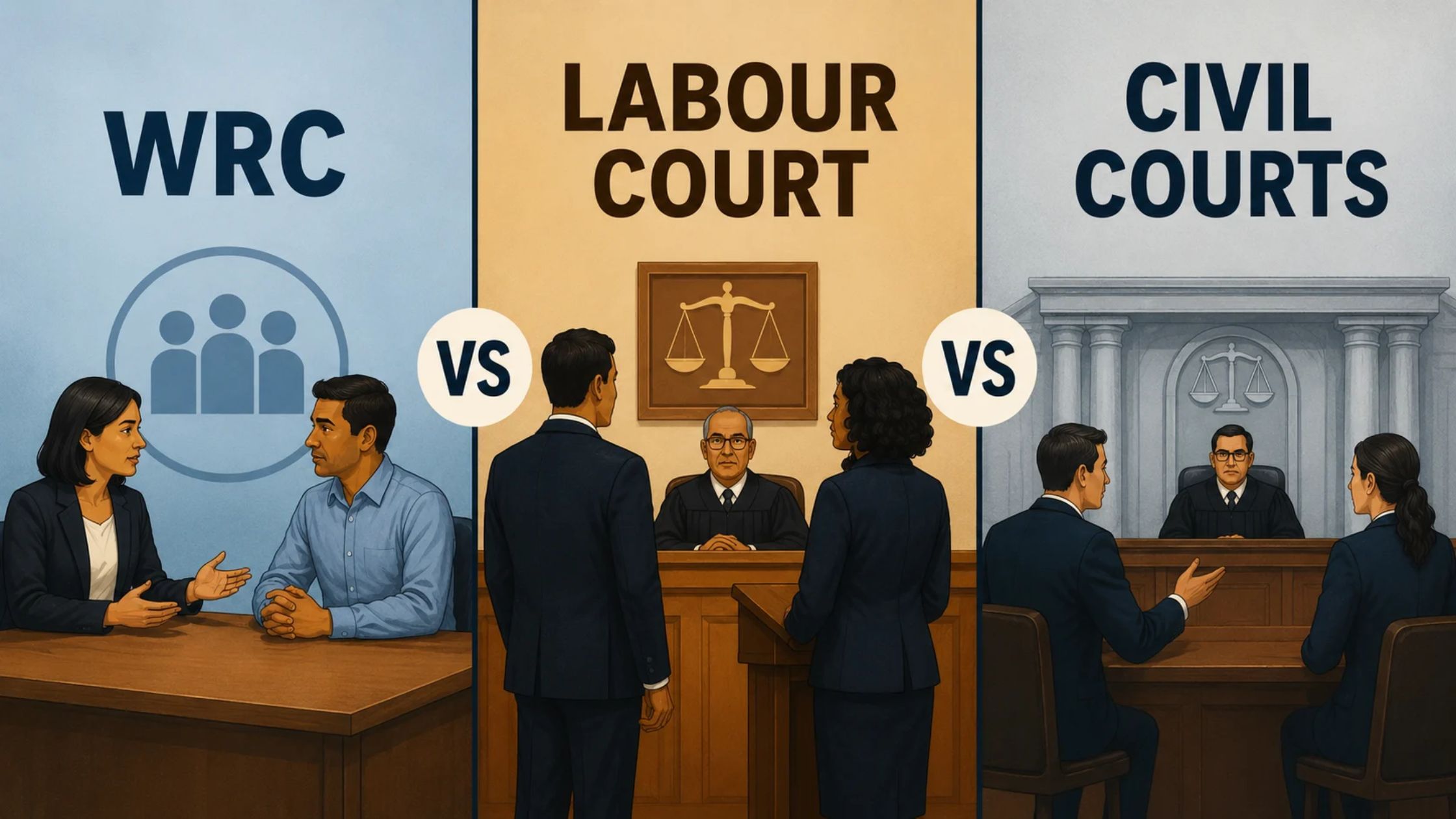
An employer’s guide to forum selection in Irish employment disputes
For an employer facing a workplace dispute, one of the first — and most consequential — questions is not “who is right,” but “where does this actually get decided?” Ireland’s employment dispute-resolution landscape is not a single system but several distinct ones, each with its own jurisdiction, procedure, and consequences for the business. Misjudging which forum applies, or assuming that all workplace disputes follow the same path, can cost an employer time, money, and strategic advantage.
This is rarely a matter of academic interest. The forum determines the applicable time limits, the evidential approach, the available remedies, and — since the Supreme Court’s 2021 decision in Zalewski — whether the employer will face a public hearing with sworn evidence or a more contained process. Understanding the distinctions between the Workplace Relations Commission (“WRC”), the Labour Court, and the civil courts is foundational knowledge for any Cork or Irish business managing employment risk.
The Workplace Relations Commission: The Default Forum
The WRC is the primary first-instance body for the great majority of individual employment disputes in Ireland. It provides an accessible, relatively informal, and cost-effective route for resolving complaints under a wide range of employment statutes, including the Unfair Dismissals Acts 1977–2015, the Employment Equality Acts 1998–2015, the Payment of Wages Act 1991, the Organisation of Working Time Act 1997, and the Protected Disclosures Act 2014 (as amended 2022).
Matters typically heard at the WRC include:
- Unfair dismissal claims
- Discrimination and equality complaints
- Disputes over pay, hours, and working time
- Bullying and harassment complaints engaging statutory protections
- Statutory employment rights claims, including certain disputes involving contractual entitlements where jurisdiction is expressly conferred by employment legislation — for example, claims under the Terms of Employment (Information) Acts, where compensation of up to four weeks’ remuneration may be awarded
- Penalisation claims arising from protected disclosures or other protected acts
It’s worth being precise here, because this is a point employers frequently get wrong: the WRC does not have a general jurisdiction over breach of contract claims equivalent to the District Court or Circuit Court. Where an employee wishes to sue for breach of contract — for example, unpaid notice, bonus disputes, share options, or other contractual entitlements — that claim will often fall to be pursued in the civil courts, unless a specific employment statute expressly gives the WRC jurisdiction over the particular issue in dispute. The WRC’s role is to enforce statutory employment rights; it is not a general forum for contractual disputes arising out of the employment relationship.
The procedural landscape here shifted materially following Zalewski v An Adjudication Officer [2021] IESC 24. The Supreme Court held that WRC adjudication involves the administration of justice and must accordingly satisfy certain constitutional guarantees. The practical consequences for employers are significant: WRC hearings are now, save in limited circumstances, held in public; evidence is generally given on oath or affirmation, with cross-examination available; and decisions are published with the parties named. Employers sometimes underappreciate this point when assessing reputational exposure — a WRC complaint is no longer a quiet, private process by default.
Employers should also note the applicable time limits: a complaint must generally be brought within six months of the alleged contravention, extendable by a further six months where the adjudication officer is satisfied there was reasonable cause for the delay.
The Labour Court: Appeals and Industrial Relations
The Labour Court occupies a different, and frequently misunderstood, position. It is best understood in two distinct capacities.
First, it functions as the sole appellate body for WRC adjudication decisions under section 44 of the Workplace Relations Act 2015. An employer or employee dissatisfied with a WRC adjudication may appeal to the Labour Court, which rehears the matter afresh — as a full de novo hearing, not a review of the original decision for error. The appeal must be lodged within 42 days of the date of the WRC decision; this period may only be extended where the Labour Court is satisfied that exceptional circumstances prevented timely lodgement, and the burden of establishing that rests with the appellant.
Second, the Labour Court retains a long-standing industrial relations function, addressing trade disputes and matters referred to it under the Industrial Relations Acts 1946–2015 — a role distinct from, and older than, its appellate function under the 2015 Act.
Employers should note the practical implications of an appeal:
- The matter is heard again in full, not merely reviewed
- New evidence may, in certain circumstances, be introduced
- The 42-day window is strict and merits calendaring the moment a WRC decision issues
- The process introduces further delay and cost, which should be weighed against the merits of appeal
- Labour Court determinations are, again, generally a matter of public record
The Civil Courts: Where Employment Disputes Escape Statutory Bodies
Not every employment-related dispute falls within the WRC’s jurisdiction. The District Court, Circuit Court, and High Court retain jurisdiction over matters that fall outside the statutory schemes administered by the WRC and Labour Court, or that a claimant elects to pursue there instead.
Matters more likely to proceed in the civil courts include:
- Common law breach of contract claims — for example unpaid notice, bonus disputes, or share options — which will often fall within the jurisdiction of the civil courts rather than the WRC, unless a specific statutory scheme confers jurisdiction on the WRC over the particular issue. The relevant civil court will typically be the District Court, Circuit Court, or High Court depending on the value of the claim
- Claims for wrongful dismissal at common law, as distinct from statutory unfair dismissal
- Personal injury claims arising from workplace conditions, including psychiatric injury
- Injunctive relief — for example, to restrain a dismissal or enforce a restrictive covenant
- Certain claims involving directors, senior executives, or complex contractual disputes not well suited to the WRC’s process
For senior executive disputes, restrictive covenants, notice clause disputes, bonus claims, and wrongful dismissal actions in particular, the High Court or Circuit Court will frequently be the relevant forum rather than the WRC.
Where injunctive relief is sought, the governing test remains that set out in Campus Oil Ltd v Minister for Industry and Energy (No. 2) [1983] IR 88 — whether there is a fair or serious question to be tried, whether damages would be an adequate remedy, and where the balance of convenience lies. Applications to restrain a dismissal or enforce a restrictive covenant are almost always argued on this framework, and an employer facing such an application should expect the analysis to turn on it.
Civil litigation also operates under a different costs regime. The general rule that costs may follow the event does not typically apply before the WRC or Labour Court, though it is worth noting this is not an absolute divide: the Labour Court and WRC retain narrow costs powers of their own, and even in the civil courts the ultimate costs outcome remains subject to judicial discretion under section 169 of the Legal Services Regulation Act 2015. That said, the general contrast — a largely costs-neutral statutory forum versus a courts system where an unsuccessful party more often bears the other side’s costs — remains a genuine and often decisive factor in an employer’s strategic calculus.
Why the Choice of Forum Matters to Employers
The forum in which a dispute is heard is not a peripheral procedural detail — it shapes the entire risk profile of the matter. Employers should consider, at an early stage:
- Which forum has jurisdiction over the claim as framed, and whether the employee has correctly identified it
- Whether the applicable time limits have been met or missed
- What remedies are actually available in that forum, and whether they align with what the employee appears to be seeking
- Whether the matter is likely to be heard in public, and what that implies for reputational exposure
- Whether the costs regime in that forum creates leverage, or removes it
- Whether parallel or overlapping proceedings might arise in more than one forum
A claim mistakenly lodged in, or strategically directed toward, the wrong forum is not always a defect the employer can safely ignore — nor is it always one on which the employer should rely without proper advice, as amendment or re-framing is often possible.
An Illustrative Scenario
The following is offered as an illustrative composite, not a description of any specific matter.
Consider an employer who dismisses a senior employee, believing the matter to be a straightforward unfair dismissal issue destined for the WRC. The employee’s solicitor instead issues High Court proceedings, framing the claim as one for wrongful dismissal at common law, alleging breach of a lengthy notice provision in a legacy contract, and seeking a Campus Oil-style injunction restraining enforcement of a post-termination restrictive covenant. The employer, having anticipated a WRC hearing, finds itself instead facing a materially different process — with different rules of evidence, different exposure to legal costs, and a different timeline entirely. Early advice on forum, taken before the dismissal was effected, would have allowed the business to anticipate and prepare for this possibility.
Getting the Forum Question Right from the Outset
For employers, the practical lesson is straightforward: the question of forum should be considered early, not left to be discovered once proceedings arrive. A dismissal, a contentious grievance, or a dispute with a senior employee may carry exposure across more than one jurisdiction simultaneously, and the correct response — including whether to negotiate, defend, or seek to have proceedings struck out or transferred — depends heavily on getting this analysis right from the outset.
Why Cork Employers Choose Dylan Green & Associates Solicitors
Navigating the intersection of the WRC, the Labour Court, and the civil courts requires more than familiarity with each forum in isolation — it requires the judgment to identify, at the earliest stage, which forum a dispute properly belongs in, and how that assessment should shape the employer’s response.
Dylan Green leads the firm’s employment law practice, advising Cork and Irish businesses across the full spectrum of workplace disputes — from early-stage grievances and disciplinary processes through to WRC representation, Labour Court appeals, and civil litigation where a matter demands it.
Clients return to the firm, and refer others to it, for a small number of consistent reasons:
- Direct access to experienced employment law advice, without layers of unnecessary process
- Clear, commercially grounded guidance on which forum applies and why
- Responsiveness at the moments that matter most, including when proceedings are first threatened or received
- A track record of guiding employers through WRC, Labour Court, and civil court matters from first contact through to resolution
The firm’s approach to client service is underpinned by a firm-wide commitment to fairness and inclusion, formally recognised with a 2025 Diversity & Inclusion Award.
For businesses in Cork and across Ireland, understanding where a dispute belongs is often the first and most decisive step in managing it well. If your business is facing a workplace dispute and is unsure of the right forum or the right response, Dylan Green & Associates Solicitors is ready to help you assess the position clearly.
Have you received a WRC complaint, a Labour Court appeal, or civil proceedings arising from an employment matter? Contact Dylan Green & Associates Solicitors for a confidential consultation before you take your next step.
Dylan Green & Associates Solicitors
Horgan’s Quay, The Waterfront Square, Cork
Phone: 021 470 8570
Email: info@greensolicitors.ie
Frequently Asked Questions
Can an employee choose whether to bring a claim to the WRC or the civil courts?
In some cases, yes — certain claims may properly be brought in either forum, depending on how they are framed. In others, the nature of the claim dictates the forum. Employers should not assume a matter is confined to the WRC simply because it arises from the employment relationship. In particular, the WRC does not have a general breach of contract jurisdiction: common law contractual claims, such as those for unpaid notice, bonus, or share options, will typically need to be pursued in the District Court, Circuit Court, or High Court, depending on their value, unless a specific employment statute confers jurisdiction on the WRC over that issue.
What happens if a WRC decision is appealed?
An appeal to the Labour Court, lodged within 42 days of the WRC decision under section 44 of the Workplace Relations Act 2015, results in a full rehearing of the matter de novo, not a review of the original decision for error. New evidence may, in certain circumstances, be admitted.
Are WRC and Labour Court hearings held in public?
Generally, yes. Following the Supreme Court’s decision in Zalewski v An Adjudication Officer [2021] IESC 24, WRC hearings are conducted in public, with evidence typically given on oath, and decisions are published with the parties named. Labour Court hearings follow the same general public footing. Employers should factor this into their assessment of reputational exposure.
Can the same set of facts give rise to proceedings in more than one forum?
Yes. A dismissal, for example, may give rise to a statutory unfair dismissal claim before the WRC and, separately, a common law claim in the civil courts, depending on the contractual terms and the nature of the employee’s role.
Should an employer seek legal advice before responding to proceedings, regardless of the forum?
Given the differing procedures, time limits, and costs regimes across the WRC, the Labour Court, and the civil courts, obtaining advice at the outset will generally assist the business in responding appropriately and avoiding missteps that are difficult to unwind later.
Disclaimer: This article is intended for general information purposes only and does not constitute legal advice. The appropriate forum for any given employment dispute depends on the specific facts and legal basis of the claim. Employers facing a workplace dispute should obtain specific legal advice before taking any significant action.